TUTORIAL – HOW TO PLAY – PRINTABLE INSTRUCTIONS!
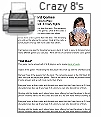
Printable page with instructions for How to Play Crazy 8s’s and Old Maid! Take this page with you on your travels! Teach these games to your kids to keep them entertained on the road.
Card games are great for traveling because a deck of cards is easy to transport anywhere, and there are so many different games you can play. Here are two of our family’s favorite card games:
“Crazy 8’s” (Crazy Eights)
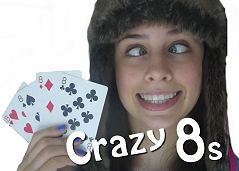
This is a great game to teach children who have never played cards before. I have found that the very basic version is the best version to play with kids who are learning card games for the first time. It can be played with 2 or more players and a standard deck of cards.
Object of the game: Be the first player to get rid of all your cards.
Deal five cards to each player (or seven cards if there are only two players). The rest of the deck is placed face down on the table to make a stockpile, and the top card is turned over and placed next to it. This starts the discard pile.
The player to the dealer’s left begins. He must either play a card onto the discard pile or he must take one from the top of the stock pile. Then it’s the next player’s turn going clockwise.
To play a card it must match either the number or the suit as the card on the top of the discard pile. For example, if the top of the discard pile is a 6 of diamonds, then a six or any diamond may be played. If it is a king of hearts, then any king or a heart may be played.
Eights are wild (and crazy!) and may be played on any card. The player who plays an eight must state the suit which must be played next. For example, if you play an eight you can say, “hearts”, and the next player must play a heart. If he is unable to play a heart, then he must draw from the pile.
Tip: Save your 8’s for when you don’t have anything else to play.
The first player who gets rid of all their cards wins!
Variations:
- Score penalty points for all cards left in your hand after someone wins. Face cards count as 10 points; eights count as 50 points, and all number cards count as face value. Play until someone gets 500 penalty points.
- Uno or Last Card: When a player has only one card left in his hand he must announce it to the other players. Failure to announce before the next person plays a card results in them having to draw from the stockpile.
- Drawing cards: Normally your turn is over if you draw a card. Some variations allow a drawn card to be played immediately if it is a legal play. Some allow more than one card to be drawn – either up to a certain number of cards, or others require you to continue drawing indefinitely until you can play.
See my Youtube video on How to Play Crazy 8’s
“Old Maid” Card Game
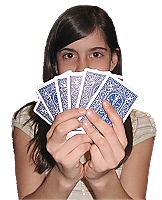
This game can be played with 2 to 8 players and a regular deck of cards.
Object of the game: Avoid being the last player who ends up with the Old Maid card.
Remove three of the queens from the deck. The remaining queen is the “Old Maid”. (Or you can use a special Old Maid deck of cards sold just for playing this game). Deal all the cards as evenly as possible among all the players. It’s OK if some players end up with more cards than others.
Everyone looks at their cards and discards any pairs that they have (such as 2 Kings, 2 sixes, etc.). Lay the discarded ones face up. If you have 3 of a kind you can only discard two of them.
Starting with the dealer, each player takes turns offering his hand face-down to the player on his left. That person randomly takes one the cards and adds it to his own hand without showing anyone. If it makes a pair, they are discarded. That player then offers his hand face-down to the next player, and so on. Players are allowed to mix up their hand before offering it to the next player.
Eventually all the cards will be paired up and discarded except for the Old Maid (the odd Queen). The player who is left holding the queen is the “Old Maid” and loses the game.
It’s hilarious to watch kids try to keep a “poker face” when they draw the Old Maid from someone’s hand!
Variation: Pairs may only be discarded when the colors match (red pairs and black pairs)
Don’t miss all the other Printable Car Games at Momsminivan.com